
Good Work Doesn't Speak for Itself
Field Notes, Issue No. 01
I've spent the last decade in rooms full of impressive people.
Accelerator cohorts. Conference tables in Niagara Falls and Calgary. Brewery floors, commercial kitchens, boardrooms, podcast studios. A decade across startups, agencies, nonprofits, and food companies, and hundreds of hours talking with founders, marketers, and business leaders about their work.
Somewhere along the way I noticed a pattern I couldn't unsee.
The people doing the most valuable work were rarely the loudest people in the room.
They were founders building remarkable companies who froze when someone asked, "so what do you do?" Employees quietly holding entire organizations together while their names never made it into the update email. Marketers making launches look so effortless that everyone assumed they were effortless.
Most people never heard their stories. Not because the stories weren't worth hearing. Because nobody had helped them tell them.¹

It was never about talent
Here's the part that took me years to accept.
It wasn't because they weren't good at what they did.
The problem wasn't talent. It wasn't intelligence. It wasn't work ethic. Some of the most capable people I've ever met are functionally invisible inside their own industries, and some considerably less capable people are extremely well known inside those same industries.
The problem was visibility.
Great work isn't automatically recognized. It has to become visible before it can become valued. That sentence sounds obvious written down. Almost nobody operates as if it's true.
We're raised on a quieter belief: do good work and the work will speak for itself. It's a lovely idea. It's also, in my experience, almost completely false. Work doesn't speak. People speak, and people can only speak about what they know exists.
Recognition changes who gets opportunities
This matters more than it might seem, because recognition isn't a vanity metric. Recognition is the mechanism that distributes opportunity.
Promotions. Funding. Speaking invitations. Partnerships. Hiring. Board seats. Media coverage.
Every one of those decisions is made by a human being choosing between the options they can see. Not the best options that exist. The options they can see.
The founder who gets the meeting isn't always the founder with the best product. She's the founder the investor remembered. The employee who gets the promotion isn't always the one holding the team together. He's the one whose contributions were legible to the person making the call.
Not because recognition creates value, but because people can only respond to the value they can see.²
I don't think this is malicious. Most people are simply busy. Decision makers aren't conducting exhaustive audits of everyone's quiet contributions. They're working with whatever made it onto their radar. Which means the radar is the game, and most talented people were never taught they were playing it.
The reframe that changed how I work
For a long time, I was uncomfortable with all of this. Visibility felt like self-promotion, and self-promotion felt like the opposite of substance. If I'm honest, I judged it a little. Prairie kid instincts run deep: keep your head down, do the work, don't make a fuss.
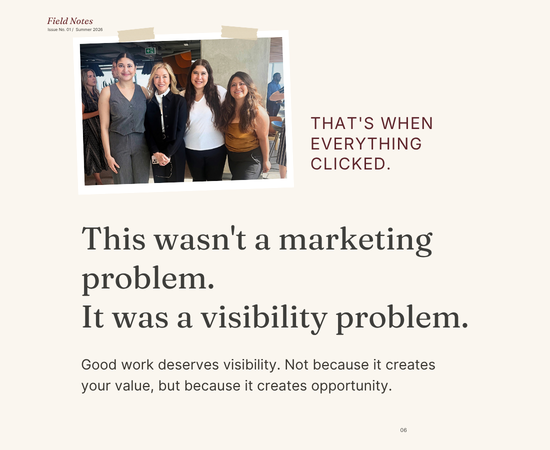
Then, somewhere between interviewing founders for a podcast and watching brilliant women get overlooked in rooms they should have owned, everything clicked.
This was never a marketing problem. It was a visibility problem, and visibility isn't self-promotion.
Visibility is translation.
It's helping people understand the value that already exists. Nothing gets invented. Nothing gets inflated. You're not manufacturing a persona or performing a highlight reel. You're building the bridge between the work you're already doing and the people who need to understand it.
The best ideas don't spread on their own. People share what they understand. People recommend what they remember. Your job isn't to be louder. Your job is to be understood.
Good work deserves to be seen
So here's the belief underneath everything I make now.
Good work deserves to be seen. Not because visibility creates your value. It doesn't. Your value exists whether or not anyone is watching, and it existed long before anyone validated it.
Visibility deserves your attention because it creates the opportunities your work deserves. When people understand your work, they can remember it, recommend it, trust it, and support it. When they don't, they can't. That's the whole equation.
Visibility isn't vanity. It's access.
What I'm building
That's the work I'm building under Field Notes.
I want to help founders, marketers, and professionals make valuable work visible. Not by turning everyone into influencers. The world has enough personal brands built on volume. By helping people communicate the value they're already creating, in their own voice, at whatever volume is actually theirs.
Because too many great ideas never receive the recognition they deserve, and I've watched too many of them belong to people in this industry, in this province, in kitchens and processing facilities and home offices across this country.
Over the coming months I'll be sharing field notes, stories, and practical ideas about visibility, recognition, and helping good work get the attention it deserves. I'm also developing workshops and resources around these ideas.
If any of this resonates, I'd love to have you along.³
-lt
¹ If you just thought of a specific person while reading this, that's exactly who I'm talking about. It might also be you.
² Visibility isn't the same thing as value. But people can only respond to what they know exists.
³ Thanks for reading this far. I don't take your attention for granted. I'll see you in the next Field Note.
